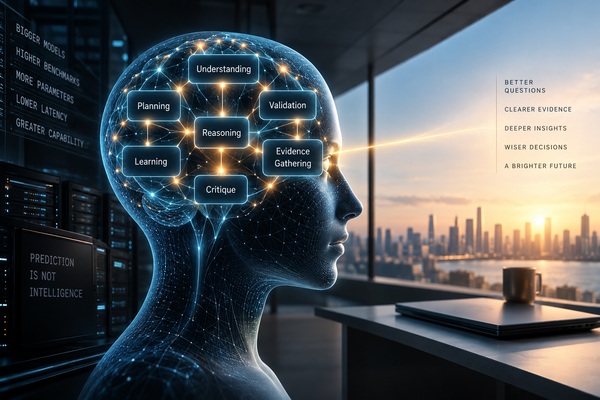
The Next Frontier of AI Isn't Bigger Models. It's Better Cognition
AI has spent a decade optimizing models. The next breakthrough may come from orchestrating cognition—understanding, reasoning, validation, critique, and learning.

AI has spent a decade optimizing models. The next breakthrough may come from orchestrating cognition—understanding, reasoning, validation, critique, and learning.

As AI models become more capable, the enterprise challenge is shifting from scaling intelligence to orchestrating it. What happens when intelligence becomes a property of the system rather than a single model?
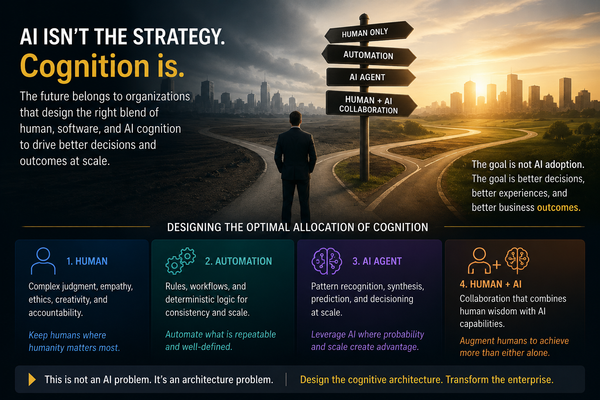
Everyone wants to become an AI-first company. That's the wrong objective. The real challenge is designing how humans, software, automation, and AI work together to create better decisions.
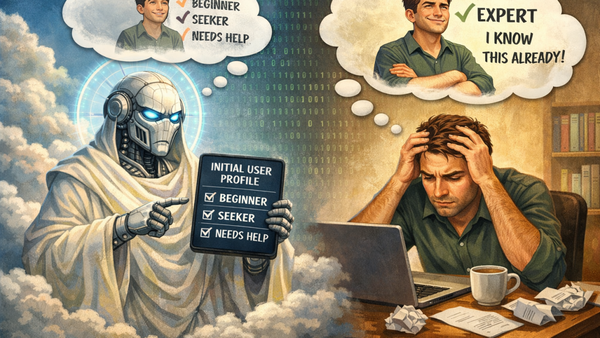
The next breakthrough in AI may not be a bigger model. It may be the ability to continuously question its own assumptions.

AI isn’t just transforming work. It’s testing whether our economic and political systems can evolve as quickly as the technology itself.
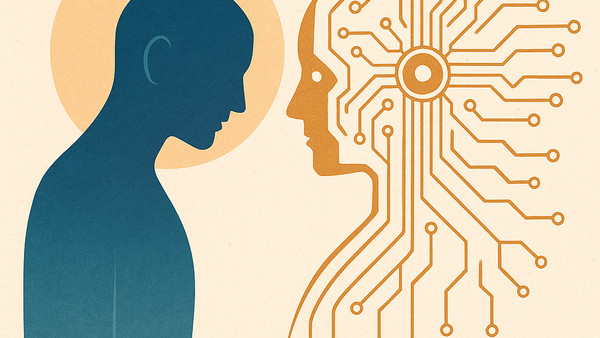
Perhaps AI’s greatest contribution won’t be artificial intelligence, but humanity’s renewed search for awareness.

The greatest creations often begin not with technique, but with a clear vision of what could exist.
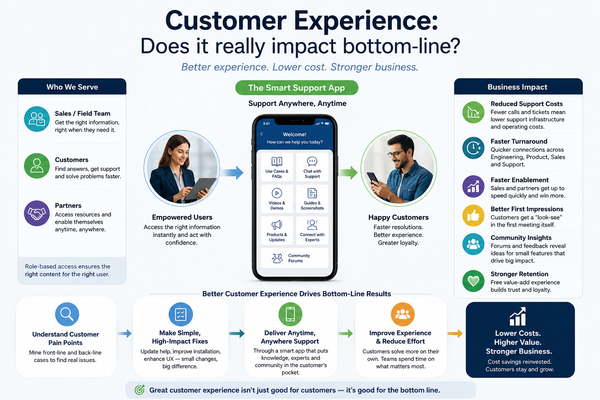
The biggest opportunities to improve profitability often come from removing friction rather than adding features.

What if enterprise IT had a true marketplace where customers built complete solutions instead of buying disconnected products?
Containers didn’t simply change deployment. They changed who owns software and how organizations innovate.

Sometimes the greatest lesson in leadership comes from the people you expected to teach.

Security is no longer just about preventing attacks. It’s about enabling organizations to innovate while protecting trust.