AI First is the Wrong Question!!
Everyone wants to become an AI-first company. That's the wrong objective. The real challenge is designing how humans, software, automation, and AI work together to create better decisions.

Every board meeting seems to begin with the same question:
"How do we become an AI-first company?"
I think that's the wrong question.
Twenty years ago, no serious CEO asked:
"How do we become an Automation First company?"
Automation wasn't the strategy.
It was one of many architectural choices available to solve a business problem.
The objective was never automation.
The objective was always better businesses, better products, better customer experiences, and better economics.
AI is no different.
Yet somewhere along the way we've started treating AI as if it's the destination rather than one possible path.
That's a mistake.
The real question isn't:
Where can we add AI?
The real question is:
How should this enterprise think?
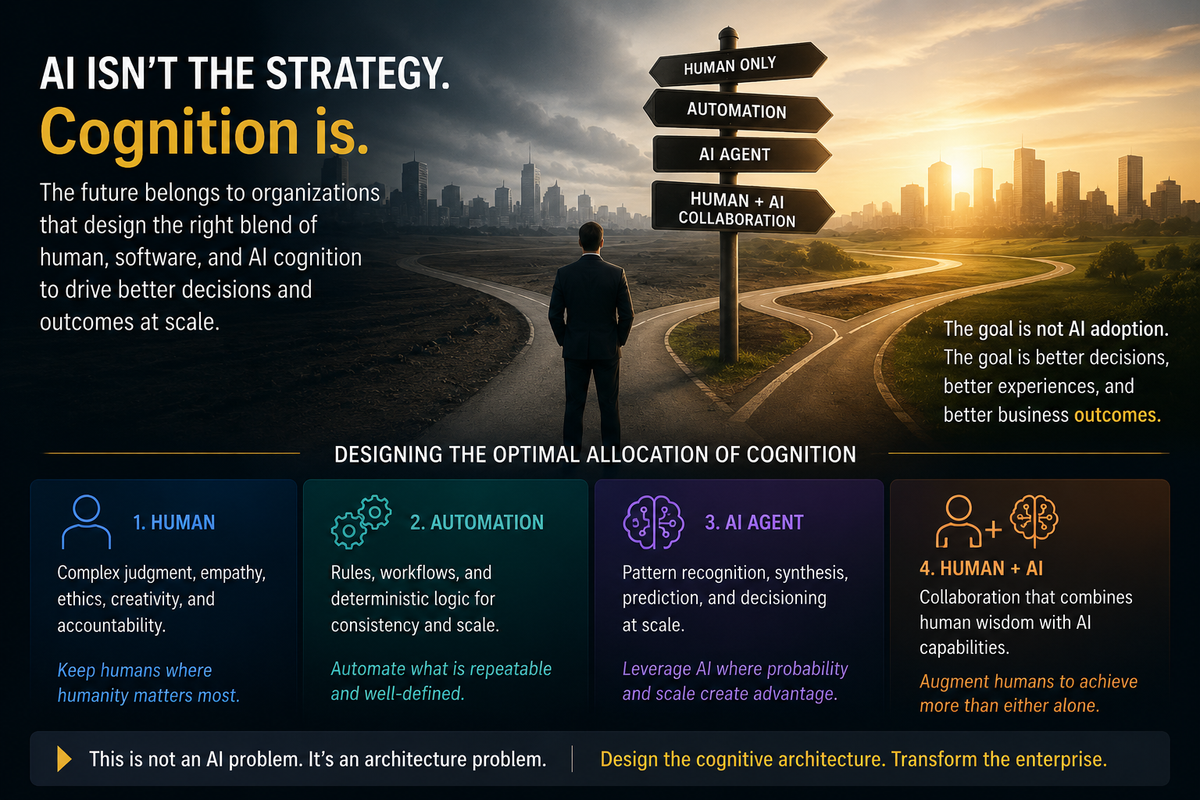
Every business capability now has four possible implementations:
- A human performs the work.
- Deterministic software and automation perform the work.
- AI performs the work.
- Humans and AI work together.
Choosing between those options isn't a technology decision.
It's an architectural decision.
The best answer rarely involves maximizing AI.
It involves optimizing the allocation of cognition.
That decision depends on far more than model quality.
It depends on:
- Trust
- Risk
- Cost
- Governance
- User experience
- Accountability
- Organizational design
For decades we designed enterprises around the flow of information.
Tomorrow we'll design them around the flow of decisions.
Some decisions should remain human.
Some should be fully automated.
Most will exist somewhere between deterministic software and probabilistic AI.
The organizations that succeed won't be the ones that deploy the most AI.
They'll be the ones that most intelligently partition cognition across people, software, and AI.
That's a different discipline.
It isn't software architecture.
It isn't enterprise architecture.
It isn't AI strategy.
It's cognitive architecture.
The future belongs to leaders who stop asking:
"Where can we use AI?"
and start asking:
"Given that AI exists, how should this enterprise make decisions differently?"
That's the question that will still matter long after "AI First" disappears from keynote slides.