Customer Experience: Does It Really Impact the Bottom Line?
The biggest opportunities to improve profitability often come from removing friction rather than adding features.

Editor's Note: This essay was originally published on LinkedIn in June 2016.
Much of the technology industry focuses on growing revenue through new products and features. Far less attention is given to reducing costs by improving customer experience. Looking back, many of the ideas in this essay resemble what we now call Product-Led Growth, Customer Success, and Self-Service. At the time, they simply felt like common sense. I’ve lightly edited this essay for clarity while preserving the original ideas.
Over my first twelve years in the software industry, I participated in numerous initiatives focused on increasing revenue, improving market share, or driving return on investment.
Very few initiatives focused on something equally important:
Reducing cost by improving the customer experience.
Looking back, two projects stand out because they demonstrated that improving customer experience is not merely about making customers happier.
Done well, it also improves the bottom line.
Initiative One: Improving the Total Customer Experience
Even during my engineering years, I found myself spending as much time understanding customer pain points as writing or testing software.
I wanted to understand:
- How customers actually deployed products.
- Where installations failed.
- Which support cases appeared repeatedly.
- What frustrated customers the most.
When our Engineering leadership launched the Total Customer Experience initiative, I joined the team responsible for analyzing these patterns.
We examined thousands of frontline and backend support cases.
Our objective wasn’t to redesign products.
It was much simpler.
Find the small problems that affected thousands of customers.
Many of the improvements were surprisingly modest:
- Better installation guidance.
- More intuitive workflows.
- Improved documentation.
- Clearer user interfaces.
- Better contextual help.
None of these changes required significant engineering investment.
Yet collectively they reduced customer frustration while lowering support costs.
Sometimes the highest-impact improvements aren’t the largest features.
They’re the smallest sources of friction.
Initiative Two: Support Anywhere, Anytime
The second initiative was an idea I developed with colleagues across the organization.
The premise was simple:
Support should be available anywhere, anytime.
By 2016, smartphones, tablets, Wi-Fi, and mobile networks had become ubiquitous.
The question naturally became:
Why should product knowledge remain trapped inside PDFs, email threads, or internal portals?
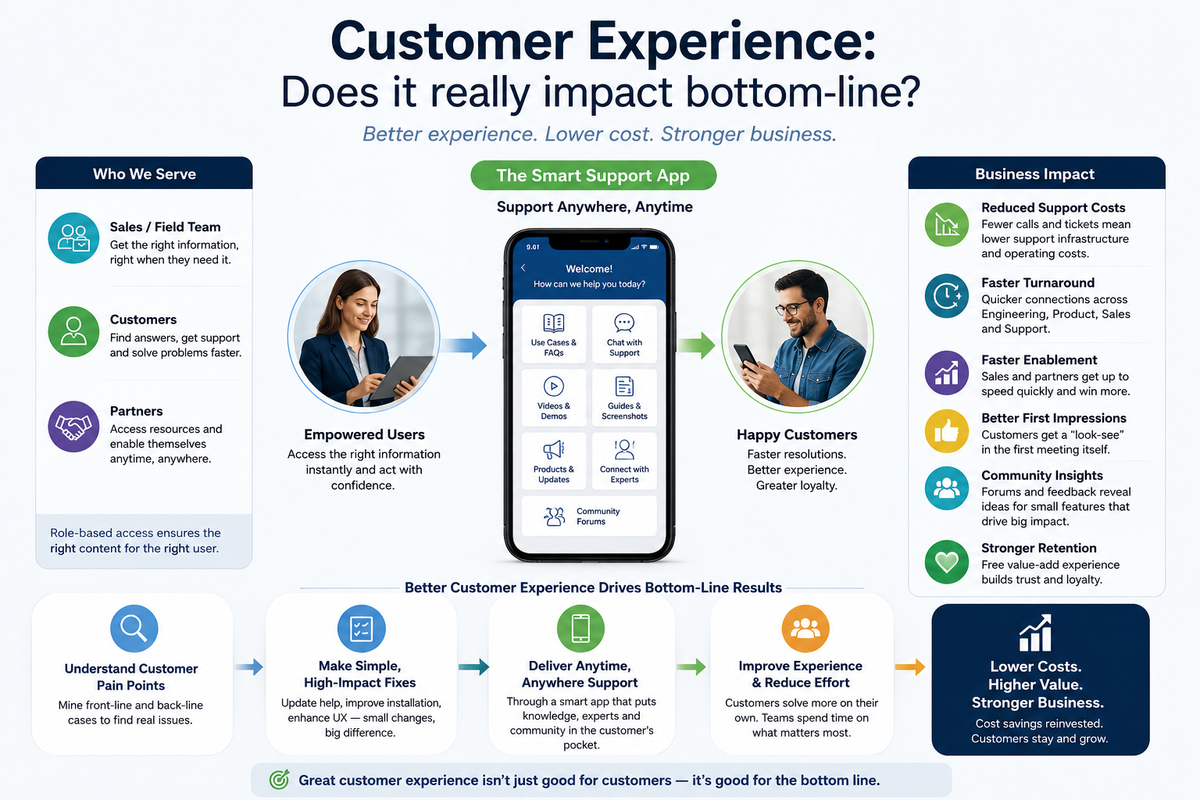
We envisioned a smart mobile application that would provide:
- Product-specific deployment guides.
- Frequently Asked Questions.
- Screenshots and walkthroughs.
- Technical documentation.
- Product demonstration videos.
- Built-in support chat.
- Direct access to Product Managers.
- Community discussion forums.
- Sales and competitive enablement content.
The platform would use Role-Based Access Control (RBAC) so every user received information relevant to their role.
Different audiences required different experiences:
- Customers
- Partners
- Sales teams
- Field engineers
One application.
Multiple perspectives.
A Simple Example
Imagine a salesperson preparing for an important customer meeting.
Instead of waiting for Product Management or Engineering to prepare presentations, they simply open the application on their tablet.
Within minutes they have access to:
- Competitive positioning.
- Product demonstrations.
- Customer presentations.
- Technical FAQs.
- Feature comparisons.
By the time they arrive at the customer meeting, they are fully prepared.
The same idea applies to customers.
Imagine a data center administrator encountering a deployment issue.
Instead of leaving the server room to search documentation or raise a support ticket, they simply open the application.
Configuration guides.
Community discussions.
Deployment screenshots.
Troubleshooting articles.
Everything is immediately available.
Knowledge reaches the customer rather than forcing the customer to search for knowledge.
Why It Matters
Improving customer experience creates benefits far beyond customer satisfaction.
Customers gain faster access to information.
Support teams receive fewer repetitive requests.
Sales teams become productive more quickly.
Partners onboard faster.
Engineering receives richer feedback.
Community discussions uncover recurring pain points and feature opportunities.
Customers experience value before they ever contact Support.
Even better…
Most of these improvements require significantly less investment than building entirely new features.
The return comes from removing friction rather than adding functionality.
Final Thoughts
Customer experience is often viewed as a soft metric.
I see it differently.
Customer experience is an operational strategy.
Every unnecessary support call…
Every confusing installation step…
Every missing document…
Every delayed response…
Represents hidden operational cost.
Improving customer experience is not simply about delighting customers.
It is one of the most effective ways to reduce complexity, lower operational costs, and strengthen long-term customer relationships.
Sometimes the best investment isn’t building something new.
It’s making what already exists dramatically easier to use.
Originally published on LinkedIn in June 2016. Republished on abhisekchaudhuri.com as part of the Collected Essays.