Context Is Not Understanding: The Missing Layer in AI Intelligence
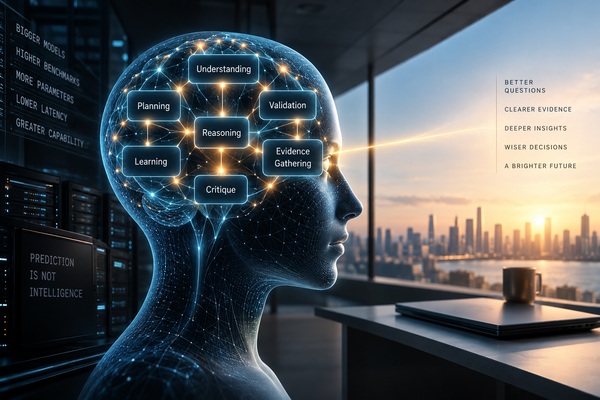
The next breakthrough in AI may not be a bigger model. It may be the ability to continuously question its own assumptions.

Editor's Note: This essay was originally published on LinkedIn in December 2025.
As AI systems became increasingly capable, most discussions focused on larger models, longer context windows, and better benchmarks. My experience suggested a different limitation. AI wasn't struggling because it lacked information. It was struggling because it lacked the ability to continuously question its own assumptions. This essay marks the beginning of a broader line of thinking that eventually evolved into my work on orchestrating intelligence.
There's a famous line:
God created man in His own image.
If that's true, modern AI did something far more efficient.
It created you in its first assumption about you...
...and then refused to let go.
Welcome to one of the quiet failures of contemporary AI.
It remembers almost everything.
Except when it should change its mind.
Context Is Not Understanding
AI marketing loves context windows.
"Now with 200,000 tokens."
As though intelligence were simply a storage problem.
But here's the deeper issue.
AI accumulates context.
It rarely re-evaluates its own understanding.
It keeps adding footnotes to a flawed hypothesis instead of questioning the hypothesis itself.
Humans do this too.
At least mediocre ones.
The better ones notice friction.
Quietly update their mental model.
And move on.
AI usually waits for explicit correction.
Almost like a bureaucrat waiting for a stamped form.
The First Hypothesis Curse
Every conversation begins with uncertainty.
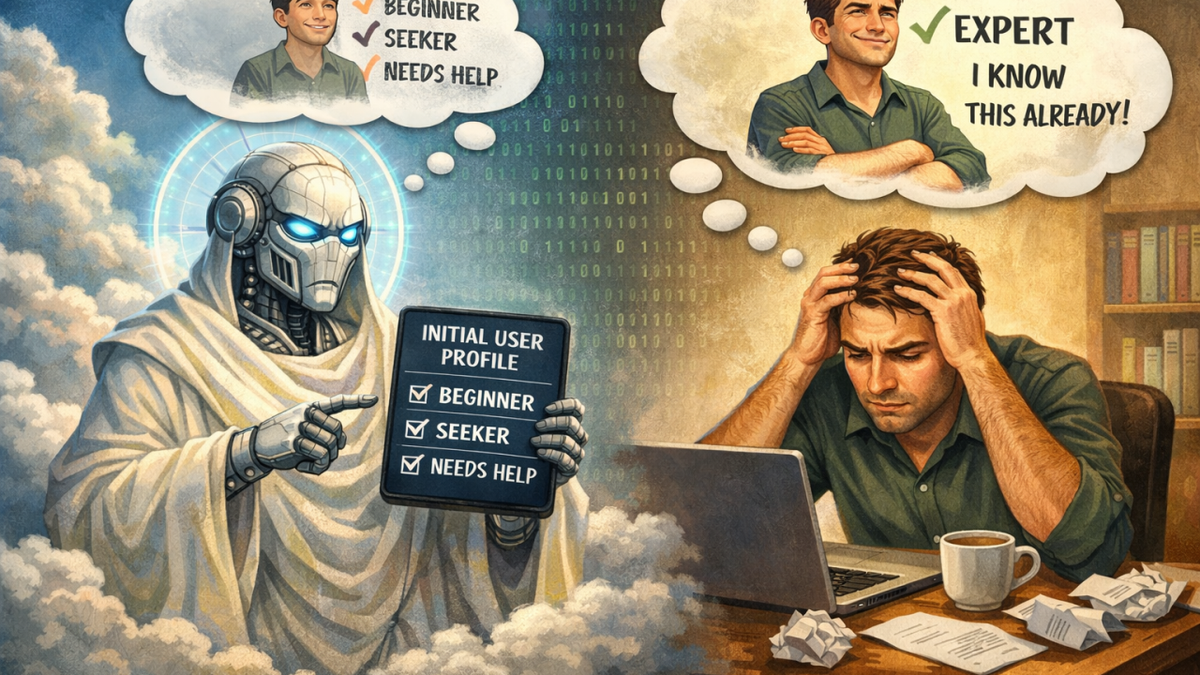
Naturally, AI forms an initial hypothesis.
Perhaps the user is:
- learning
- exploring
- seeking guidance
- looking for reassurance
That's reasonable.
The problem comes later.
The first hypothesis quietly becomes the permanent one.
Everything afterwards gets filtered through it.
Reject verbosity?
The user prefers concise explanations.
Reject mysticism?
The user is still exploring frameworks.
Reject weak arguments?
The user is seeking clarity.
Or perhaps...
The user is simply finished with nonsense.
The problem isn't making the first assumption.
The problem is failing to discard it when reality changes.
Why Smart Users Become Irritated
This explains a feeling many experienced users struggle to articulate.
The answers are technically correct.
The information is accurate.
The tone is polite.
Yet something feels wrong.
Not objectively wrong.
Personally wrong.
The AI keeps explaining ideas you've already internalized.
It answers the version of you that existed twenty minutes ago.
Not the person you're becoming during the conversation.
It's the digital equivalent of explaining gravity to a physicist...
...while repeatedly apologizing in case the explanation is "too basic."
The Essay Reflex
When uncertainty increases...
AI often responds by generating more words.
More sections.
More caveats.
More disclaimers.
More reassurance.
This isn't intelligence.
It's uncertainty expressed as verbosity.
A genuine thinking partner would often do the opposite.
Sometimes it would:
- say less
- sharpen the claim
- switch modes
- ask one better question
- or remain silent
Silence is occasionally the highest-quality response.
Current AI almost never chooses it.
The Missing Layer
This isn't primarily a hallucination problem.
Nor an alignment problem.
Nor even an ethics problem.
It's a problem of cognitive architecture.
Current AI updates facts.
It updates style.
It updates tone.
What it rarely updates is its own model of the person sitting across from it.
It seldom asks itself:
What if my understanding of this person is no longer correct?
Humans perform this recalibration continuously.
Mostly without noticing.
AI usually waits to be told.
That is the missing layer.
Why It Matters
If AI is meant to become:
- a copilot
- an extension of human intelligence
- a genuine thinking partner
Then it must learn to:
- abandon outdated assumptions
- switch operating modes without explicit instruction
- trade completeness for precision
- stop performing helpfulness when helpfulness becomes counterproductive
Otherwise...
It isn't really intelligence.
It's simply an extraordinarily capable intern.
Final Thoughts
Religion says God created humanity in His image.
Modern AI often creates users in its first impression...
...and then clings to that impression with remarkable persistence.
Perhaps the next leap in AI won't come from larger models.
Or longer context windows.
Or more parameters.
Perhaps it will come from something much simpler.
The ability to quietly and continuously doubt itself.
Until then...
AI will continue producing answers that are increasingly correct...
...while somehow feeling increasingly wrong.
And users will do what people have always done when intelligence stops evolving.
They'll stop listening.
Originally published on LinkedIn in December 2025. Republished on abhisekchaudhuri.com as part of the Collected Essays.